 Quantority
MET open interest jumps +55.1% in 24h — fresh leverage is entering
Total MET open interest now stands at $11.4M. Funding is -0.67% annualized.
 MET
MET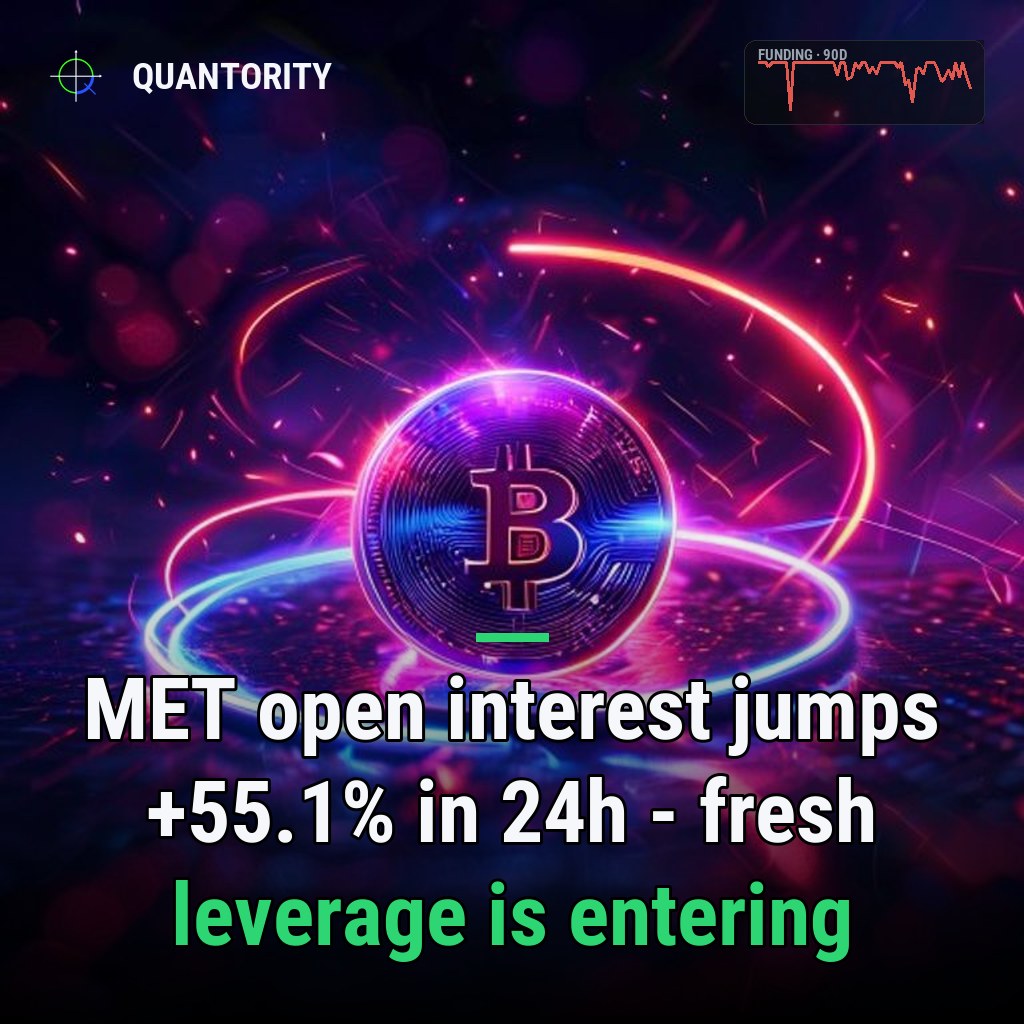
- •MET leads with 42 leverage risk.
- •1 market covered · data as of Jul 15, 2026.
| Coin | Funding APR | Pctile 90d | Open interest | OI 24h | Risk |
|---|---|---|---|---|---|
| MET | -0.67% | 12 | $11.4M | +55.1% | 42 |
MET is displaying a rare and asymmetric squeeze: shorts are being paid to hold, yet open interest is exploding at both the daily and weekly horizon, and liquidations are heavily tilted toward long positions. The combination suggests a market that is building leverage in a way that feels counterintuitive—cheap funding paired with explosive leverage growth often precedes fragility, especially when one side of the market is being systematically unwound.
Key takeaways
- MET's -0.67% annualized funding rate places shorts in a structural advantage, yet leverage is not contracting; it is expanding sharply.
- Open interest jumped +55.1% in the last 24 hours and +50.8% over the past week, signaling rapid leverage accumulation despite negative funding incentives.
- Liquidations show extreme directional bias: +1.00 imbalance means nearly all liquidations over 24 hours were long-side closures, with no short liquidations recorded.
- The leverage risk score of 42 reflects moderate structural fragility, lower than peak extremes but elevated enough to warrant attention given the OI momentum.
The funding paradox: negative rates, rising leverage
Funding rates typically act as a relief valve for crowded positioning. When longs dominate, funding turns positive and shorts are rewarded, encouraging deleveraging. MET is doing the opposite. The -0.67% APR means shorts are paying longs—a signal that the market has more shorts than typical, or that net notional positioning favors shorts. Yet instead of longs closing under this unfavorable rate, open interest is climbing hard.
The negative funding rate should discourage new longs, yet OI is rising 55% daily—a sign of leverage chasing despite unfavorable cost.
This inversion is material. Normally, rapidly rising open interest accompanies positive funding (longs crowding in). Here, longs are entering or adding despite bearing a cost to hold. That behavior often reflects either forced liquidation cascades pushing shorts out, or speculative conviction strong enough to absorb the funding drag. Neither is a sign of healthy positioning distribution.
The funding_percentile_90d of 12 further clarifies the picture. This reads as unusually far toward the short-paid extreme of MET's recent range. Over the last 90 days, funding has rarely dipped this low. Short funding reward is at its 90-day low boundary—a condition that has held in only the bottom 12% of that window. This is not a crowded long market; it is a market where shorts have structural advantage, yet the cost of that advantage is not stopping new leverage from entering.
Open interest momentum outpacing funding signals
The 24-hour and 7-day open interest changes paint a picture of sustained, aggressive leverage building. +55.1% daily and +50.8% weekly climbs are severe in absolute terms and especially notable given the scale of the market: MET's total open interest is $11.4M notional, meaning these percentage swings represent real margin being deployed at a blistering pace.
This growth would be less alarming if accompanied by positive or neutral funding (indicating synchronized long entry). Instead, it is happening under structural short advantage. That mismatch suggests the leverage is not organically distributed—it is concentrated or forced. Either new shorts are being liquidated and replaced by longs (explaining the liquidation imbalance below), or leveraged long positions are entering against the funding incentive, gambling on price appreciation strong enough to overcome the daily funding drain.
Neither scenario is stable. Leverage added in opposition to funding signals tends to be sticky only if followed by quick price moves in the direction of the new positions. Without that, the daily funding drag eats into margin and forces early closes or cascading liquidations.
One-sided liquidation pattern signals acute long stress
The liquidation_imbalance of +1.00 is the starkest red flag in this dataset. A value of +1.0 means that, over the last 24 hours, 100% of liquidations were long-side closures and 0% were shorts. This is an extreme and rare state. It indicates that longs are being forcibly removed from the market—either through price action against them, or through margin depletion due to the funding rate drag.
When paired with rising open interest, this pattern suggests a churn dynamic: shorts are exiting (or being liquidated), their positions are being covered, and new longs are entering. The net flow is long-skewed, but the turnover is violent. This kind of liquidation asymmetry often precedes either a sharp reversal (once short liquidations begin) or a run in the direction of the surviving positions (if long-heavy conviction persists and price moves with it).
Leverage risk score in context
MET's leverage risk score of 42 sits in the moderate band—neither peak danger nor complacency. This score aggregates the open interest scale, funding tenor, and liquidation imbalance into a single fragility gauge. At 42, the market is flagged as elevated but not in an extreme state. That said, when paired with the specific composition of the data—negative funding, explosive OI growth, and one-sided liquidations—the 42 should be read as a floor, not a ceiling. The ingredients for fast deterioration are in place.
What would change this read
The current read hinges on three dynamic conditions: negative funding persisting despite rising leverage, one-sided liquidation pressure on longs, and rapid OI accumulation. Any of these reversing materially would shift the narrative. If funding normalized into positive territory, it would signal that longs have become the crowded cohort and the system is self-correcting. If liquidation imbalance flipped to short-heavy (negative), it would mean the long queue is thinning and shorts are under stress instead. If open interest growth slowed or reversed—particularly if the 24h or 7d changes turned negative—it would indicate deleveraging and a cooling of the leverage chase. Monitoring these three fields daily is essential to detecting whether MET's current state is a transient imbalance or the setup for a larger unwind.
*Analysis generated from Quantority's live cross-exchange data pipeline. Descriptive market data, not a trade recommendation.*
Funding-spike and liquidation-cascade alerts the moment they fire, plus unlimited history and a REST API.
See what's in Pro→How to read this
| Funding APR | Annualized, OI-weighted funding. Positive = longs pay shorts (crowded longs). |
| Percentile 90d | Where current funding sits within the coin's own last 90 days (0–100). |
| Open interest | Total USD value of outstanding perpetual contracts. |
| OI change 24h / 7d | How fast leverage is entering (+) or unwinding (−) over the period. |
| Liquidation skew | Imbalance of forced closures (−1…1): + = more longs liquidated, − = more shorts. |
| Leverage risk | 0–100 composite of funding extremity, OI momentum, liquidations and volatility. |
Read next
 BONK
BONK
BONK open interest jumps +94.7% in 24h — fresh leverage is entering
Total BONK open interest now stands at $33.6M. Funding is -127.11% annualized.
 ARC
ARC
ARC open interest jumps +15.1% in 24h — fresh leverage is entering
Total ARC open interest now stands at $30.1M. Funding is 83.78% annualized.
 SKHY
SKHY
SKHY open interest jumps +56.4% in 24h — fresh leverage is entering
Total SKHY open interest now stands at $33.7M. Funding is -26.46% annualized.
Leila reports on the macro backdrop for crypto derivatives — rates, liquidity and cross-asset moves — and how they show up in funding and leverage on Quantority's screeners.
Stretched markets, building leverage and the research worth reading — one short email.
Every figure here is read directly from Quantority's cross-exchange data. This is descriptive market analysis — a read on positioning, not a forecast, and not financial advice.